
Saliva is the free buffer
Bagged bicarbonate has a line item. The cow’s own alkaline saliva is the larger buffer — and it only arrives when she chews.
3 min read · 2026-09-09
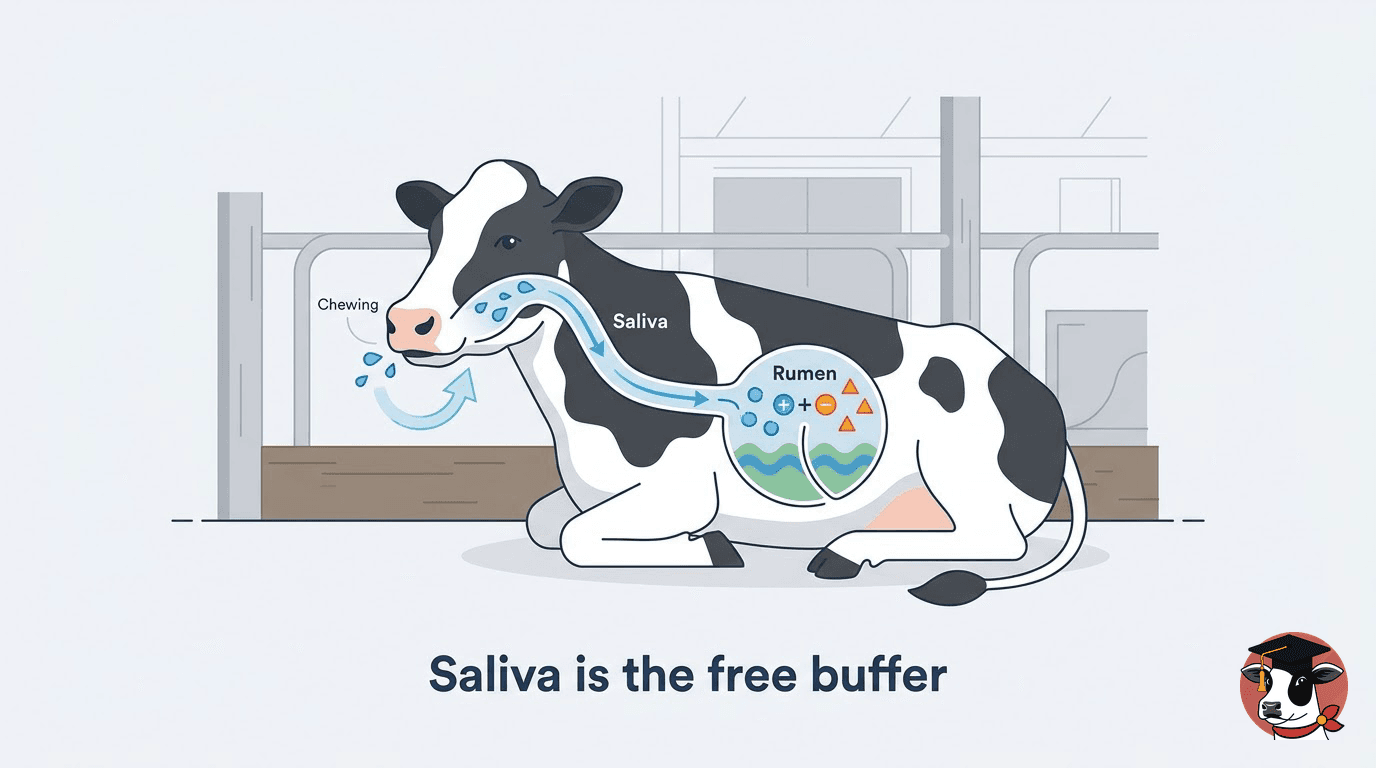
Walk a freestall after the second delivery and you can hear the difference before you see it. Quiet pens that still have full bunks often have cows that ate fast and then stopped chewing. The mixer ticket may look balanced. The free buffer may already be thin.
Penn State’s From Feed to Milk puts the scale in farm units: a mature cow chewing six to eight hours a day can secrete more than about 47.5 gallons of saliva. That fluid is not plain water. Classic composition tables put mixed cattle saliva near 126 mEq/L bicarbonate and 26 mEq/L phosphate, with sodium as the matching cation — alkaline enough to neutralize fermentation acids as they form. Reviews of ruminal pH regulation add the same chemistry in molar terms: at high salivary flow, bicarbonate delivery into the rumen can reach on the order of tens of moles per day. Saliva is the cow’s continuous drip of free buffer.
Flow is not constant. Eating and ruminating raise secretion far above resting rates; high-moisture forages and fine or pelleted feeds cut saliva per pound of dry matter — Penn State notes roughly half the saliva per pound on wet feeds versus long hay, and far less still on grainy pellets. Beauchemin’s Journal of Dairy Science review is useful here for proportion: lactating cows commonly spend about 4.5 hours eating and about 7 hours ruminating, yet a modest change in chewing time alone does not buy a large net change in rumen buffering. The practical lesson is not “add ten more minutes of cud and call it fixed.” It is that saliva is necessary, free, and fragile — and that bagged sodium bicarbonate (or sesquicarbonate) is an aid for high–corn-silage or low-fiber diets, not a replacement for the endogenous stream.
What to check without rewriting the ration: empty hours that force slug meals; heat or sore feet that steal night rumination; water access that limits the fluid needed to make saliva; and whether the pen still looks “full” while the jaws have gone quiet. Sister notes on this universe already cover milk fat as the tank alarm, cud counting as the cheap sensor, and particle size as the mat. This note is the chemistry underneath those signs: if bicarbonate is not arriving in saliva, the vat is running on borrowed pH.
Treat endogenous saliva bicarbonate as the primary rumen buffer; dietary sodium bicarbonate is a supplement, not a substitute for chewing-driven flow.
Sources
- From Feed to Milk: Understanding Rumen Function — Penn State Extension
- Invited review: Current perspectives on eating and rumination activity in dairy cows — Beauchemin 2018, Journal of Dairy Science
- RUMINANT NUTRITION SYMPOSIUM: Role of fermentation acid absorption in the regulation of ruminal pH — Aschenbach et al. 2011, Journal of Animal Science
- Nutrient Requirements of Dairy Cattle, 8th revised edition — National Academies (NASEM, 2021)
- Rumen Acidosis in Dairy Cattle – A Cause for Concern? — OSU Buckeye Dairy News